


Weatherit is summer, but there are no guarantees
June at 58 degrees north
June is one of the quietest months of the year on the northern North Sea. That is not a promise: depressions cross it in summer too, and at this latitude they have more room to deepen than further south.
A few things to reckon with in this period:
Cold water
The sea is still cold in June, even in sunshine. That makes hypothermia a real risk in a man-overboard situation, and it is why the nights on deck are genuinely chilly. Dress in layers and take more warm clothing than you think you need.
Sea fog and visibility
Warm air over cold water produces haze and fog. Around Orkney and Shetland that is not unusual in spring and summer. Expect to do part of the approach on instruments: radar or AIS, and a proper lookout routine.
Light
At this latitude it barely gets dark at night in June. That makes sailing more pleasant and keeping a lookout easier, but it also upsets your sleep rhythm. Bring an eye mask.
The Norwegian coast
Among the skerries and in the fjords the wind behaves differently from at sea: it accelerates through narrows, dies in the lee of a rock face, and bends with the landscape. Expect more engine hours than offshore, and less predictability.
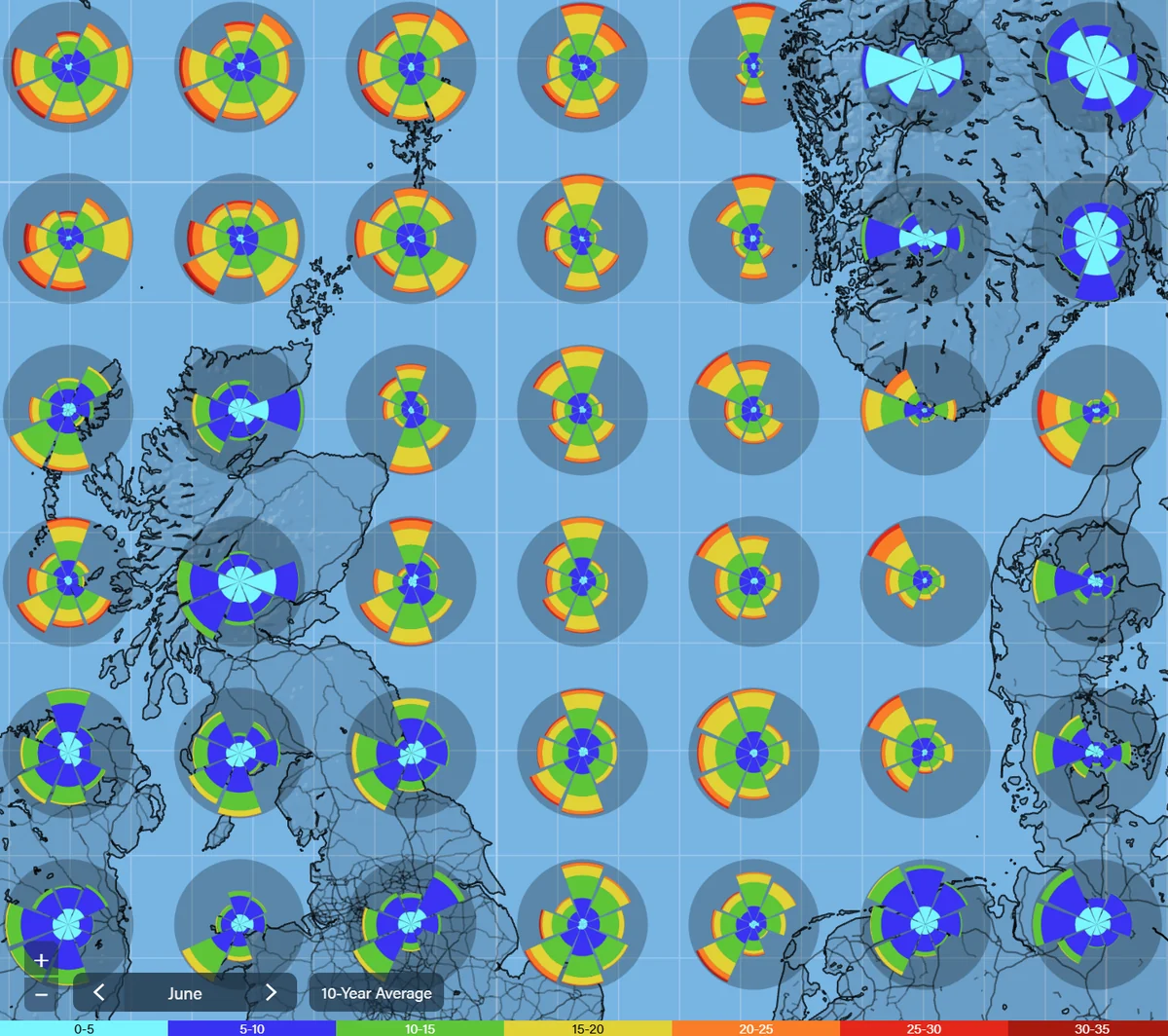
Wind roses for June on the North Sea, ten-year average. Each rose covers one area; the direction of a sector is where the wind comes from, its length how often, and the colour the wind speed in knots. Source: information meeting presentation.
The climate picture
Climate data say nothing about the week you happen to sail, but they do give a feel for what is normal: prevailing wind direction, average wind strength, and how often it really blows. Use them to calibrate your expectations — not to fix your route.
What stands out in June: the wind often comes from the west to north-west, and the northern part of the route averages more wind than we get off our own coast. Force 5 and above occurs regularly on every leg.
Where to get your forecast
Use more than one source, and pay particular attention to where they disagree. When the models differ, uncertainty is high — and that is information in itself.
- KNMI maritime — warnings and forecasts for the North Sea;
- Met Office Shipping Forecast — for the British sea areas, including Fair Isle and Forties;
- yr.no — the Norwegian institute, strong for the Norwegian coast and fjords;
- Windy — to compare models side by side (ECMWF, GFS, ICON).
At sea
Out of mobile range you need another route. Consider:
- NAVTEX for warnings and safety information — one of the three GMDSS rules is that you can always receive those;
- VHF: coastguard broadcasts on the announced channels;
- a satellite link for GRIB files, for instance through an Iridium device or PredictWind;
- and the good old barometer, plus your own eyes. A rapidly falling pressure and a changing sky tell you something before the model does.